Galvanised steel
Galvanised steel with plated fasteners, for general warehouse and distribution duty.
01Engineered solution
Getting packages down from a mezzanine does not always need a powered conveyor. A spiral chute lowers light product by gravity, and a stair-step floor keeps it moving instead of letting it wedge on the way round.
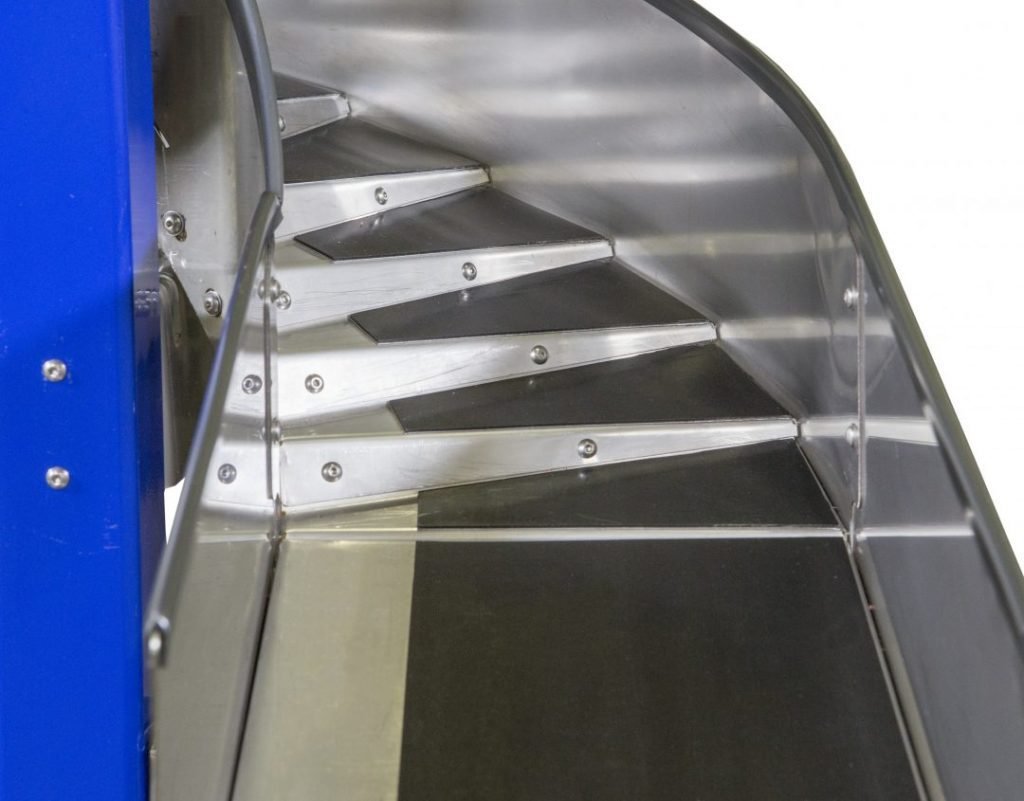
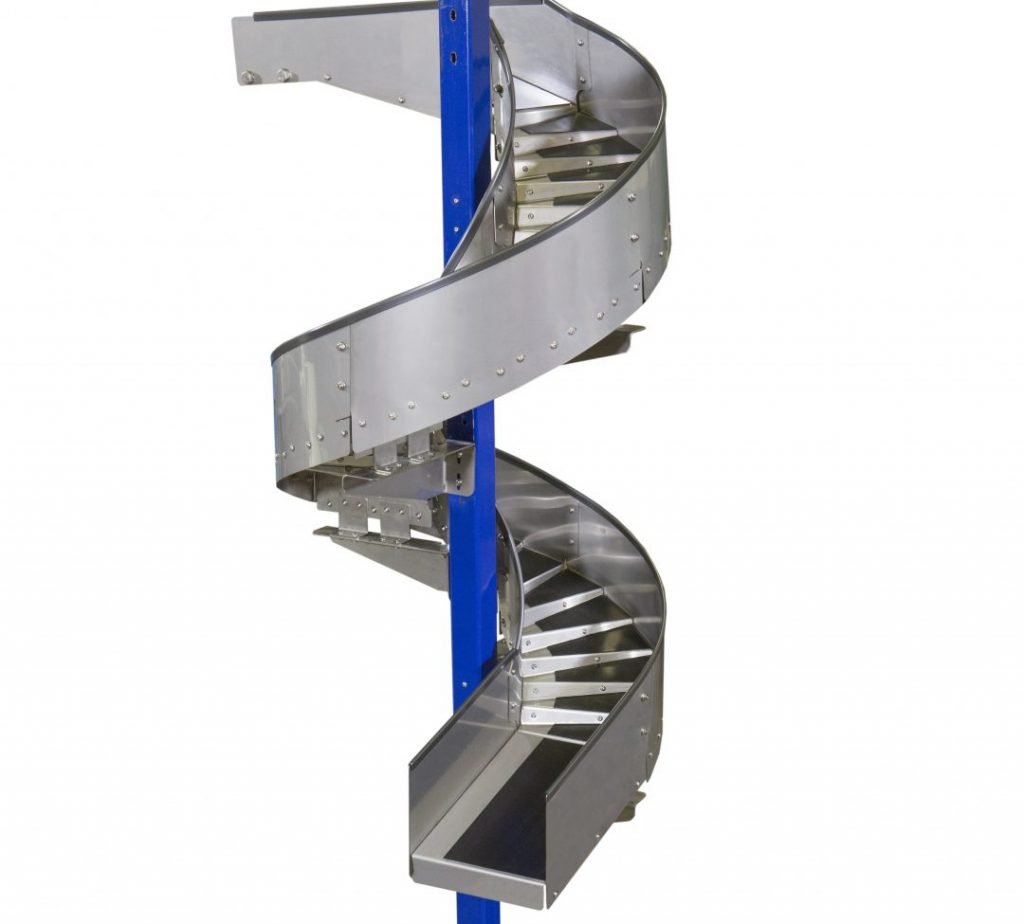
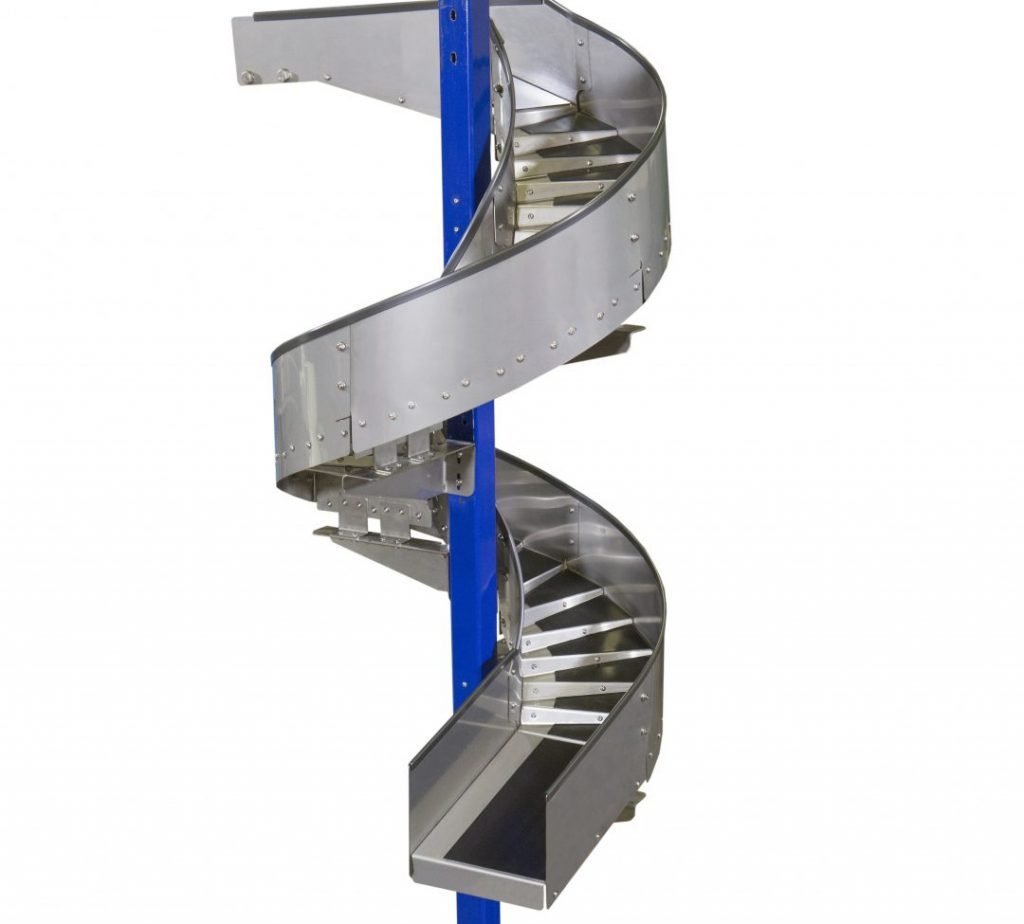
 Stair-step floor
02Principle
A spiral chute lowers products gently and economically from overhead conveyors, mezzanines or platforms. There is no drive, no belt and no power, so the running cost is nil and there is very little to maintain.
The problem with a plain gravity spiral is that product stalls on the curve and the next item lands on it. A stair-step floor design keeps product moving even when it has accumulated, which is what makes the chute self-clearing.
The chute handles different products simultaneously rather than needing a sorted, single-format flow, which matters when it is fed from a mixed line above.
03General specifications
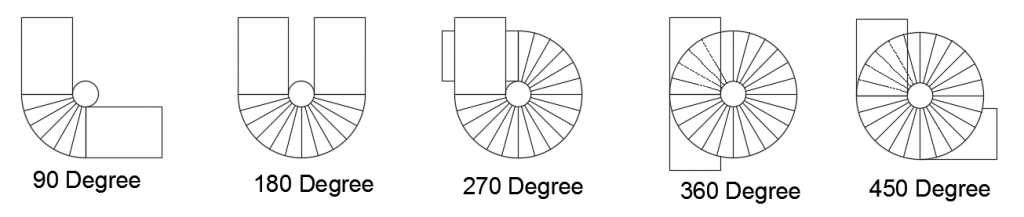
Chute geometry is set by width, and the height it has to drop decides the spiral angle.
04Construction
Bolt-together construction throughout, so the chute ships assembled and goes in quickly.
Galvanised steel with plated fasteners, for general warehouse and distribution duty.
300 Series stainless with a #4 polish and stainless fasteners, where the environment or the cleaning regime requires it.
UHMW bottom liner and wall liner options are available where product needs a lower-friction or more forgiving surface.
Tubular steel or stainless steel stand options, with custom infeed and exit chutes to suit what feeds the spiral and what receives it.
05What it handles
A spiral chute suits lightweight packages rather than heavy or rigid unit loads.
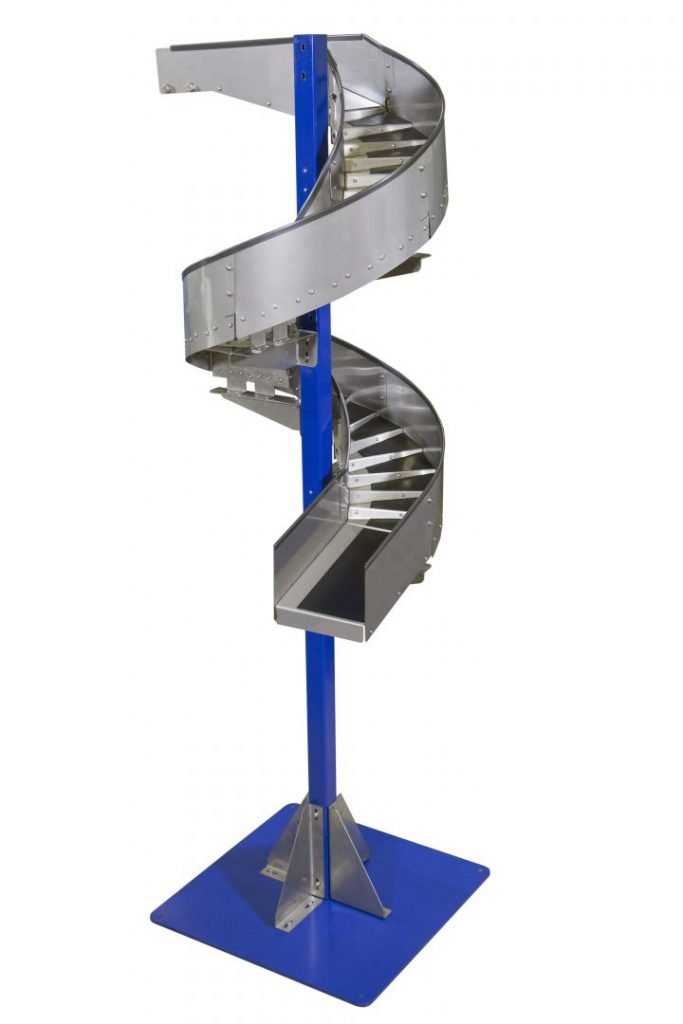
The common case: cases coming off a mezzanine or an overhead run.
Lighter cartons and card packaging that would be damaged by a hard drop.
Flexible pouches that will not travel reliably on a steep powered incline.
Bagged and filmed product where shape varies between items.
Several product types descending at once, without sorting them first.
Product that has backed up in the chute still clears, because of the stair-step floor.
06Gallery
Geometry, discharge and a 450° spiral.

07Frequently asked questions
Limits, materials and what the installation needs.
Maximum infeed height is 144 in and minimum discharge height is 18 in. The spiral angle needed follows from that drop, in 90° increments from 90° up to 450°.
Between 1 oz and 50 lb, with product lengths from 3 in. It is designed for lightweight packages rather than heavy unit loads.
The stair-step floor design is there specifically to prevent that. Product keeps moving even when it has accumulated in the chute, which is why it is described as self-clearing.
No. It is a gravity chute, so there is no drive, no belt and nothing to run.
It ships assembled and is bolt-together construction, so installation is fast. The chute must be lagged to the floor.
08Related solutions
A chute is one of several ways to change level.
Give us the infeed height, the discharge height and what is coming down, and Roarer can specify the chute width, radius and spiral angle.
Discuss your application