01
Choose the conveyor early
Treating the conveyor as a late machine accessory can leave too little space for a reliable transfer or drive. Define infeed, internal movement, machine-to-machine bridges and the main product route while the surrounding equipment is still being designed.
02
Solve the small-part failure modes
End transfers need rollers small enough to avoid a product-sized gap. Side transfers need bearing supports that do not project beyond the belt edge. Thin belts must remain flat under light products, and short conveyor sections need a drive arrangement that fits inside the available machine envelope.
03
Use low-tension drive design
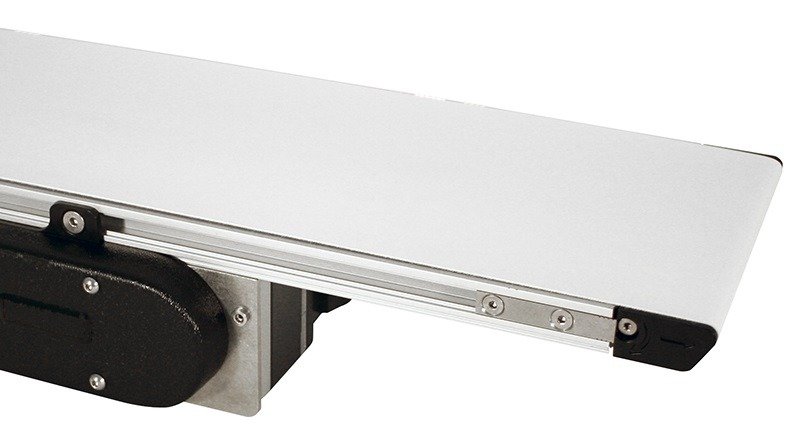
The archived guide describes miniature conveyors with 5/8-inch end rollers, a 1/4-inch belt-edge gap in a side-transfer arrangement and a spring-loaded pinch drive. By generating traction at the drive roller rather than through high belt tension, the design supports small bearings and a flatter belt.
- Test fragile products through every transfer
- Preserve orientation for vision, filling and robotic handling
- Leave access for tracking, cleaning and belt replacement
Field checklist
Application checklist for miniature conveyors
Miniature conveyors are most useful when the transfer is designed around the actual component rather than nominal belt width alone. Small end rollers support end-to-end transfers; a flush side arrangement supports machine-to-machine hand-off; low-tension belting helps light products remain flat for inspection and robotic pickup.
- Record the smallest stable product footprint, not only its overall length
- Check gaps at every end and side transfer
- Confirm the drive and return path fit inside the host machine
- Test orientation at the intended speed and acceleration