01
Three platform patterns
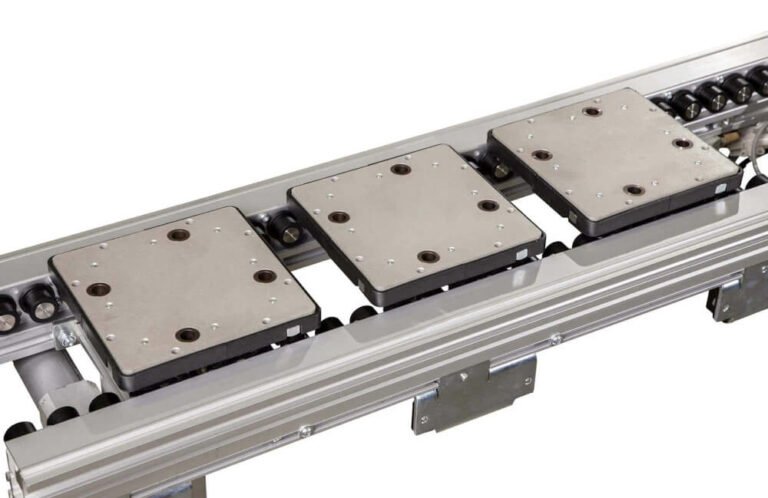
Pallet systems commonly carry workpieces on a dual-belt conveyor powered by a common drive, on flexible plastic chain, or on rollers supporting the pallet edges. The source is a short eBook landing page, so this guide keeps the comparison deliberately concise.
02
Compare against the process
Check pallet and product mass, required positioning, transfer direction, accumulation method, clean access and the modules needed for stopping, locating, lifting or rotating. The surrounding machine layout also determines whether open access beneath the pallet is important.
03
Validate the complete loop
A pallet is part of a recirculating system, not an isolated carrier. Review empty-pallet return, queue capacity, identification or sensing, operator access and recovery from a stopped station before selecting the platform.
Field checklist
Compare the workpiece interface as well as the conveyor
Pallet-system selection includes the carrier, locating method and station modules. Review how the pallet stops, lifts, rotates, transfers and returns, and whether the workpiece needs access from below. A higher-capacity platform is not automatically the better choice if its modules, footprint or positioning method do not suit the process.
- Define pallet and payload mass separately
- List every station function
- Plan empty-pallet return and buffering
- Confirm identification, sensing and recovery from a blocked station