01
Accuracy is a system result
Labelling, printing, robotic pick-and-place and indexing depend on the product arriving within a useful position window. Belt travel alone is not enough: pulley geometry, tracking, tension, product friction, transfers and controls all contribute to the final result.
02
Control the belt
Crowned rollers use pulley shape to encourage a friction-driven belt toward the centre. V-guides or other guided-belt arrangements constrain side-to-side movement more directly. Positive-drive timing belts remove slip between the belt and drive pulley, which is especially valuable in indexed motion.
03
Control the product
Even an accurately driven belt cannot prevent every product from sliding. Side guides, fixtures, pockets or pallets can preserve orientation and locate the workpiece. Define the required repeatability at the process point, then test the real product at the intended speed, acceleration and transfer conditions.
Field checklist
Build repeatability into the complete motion path
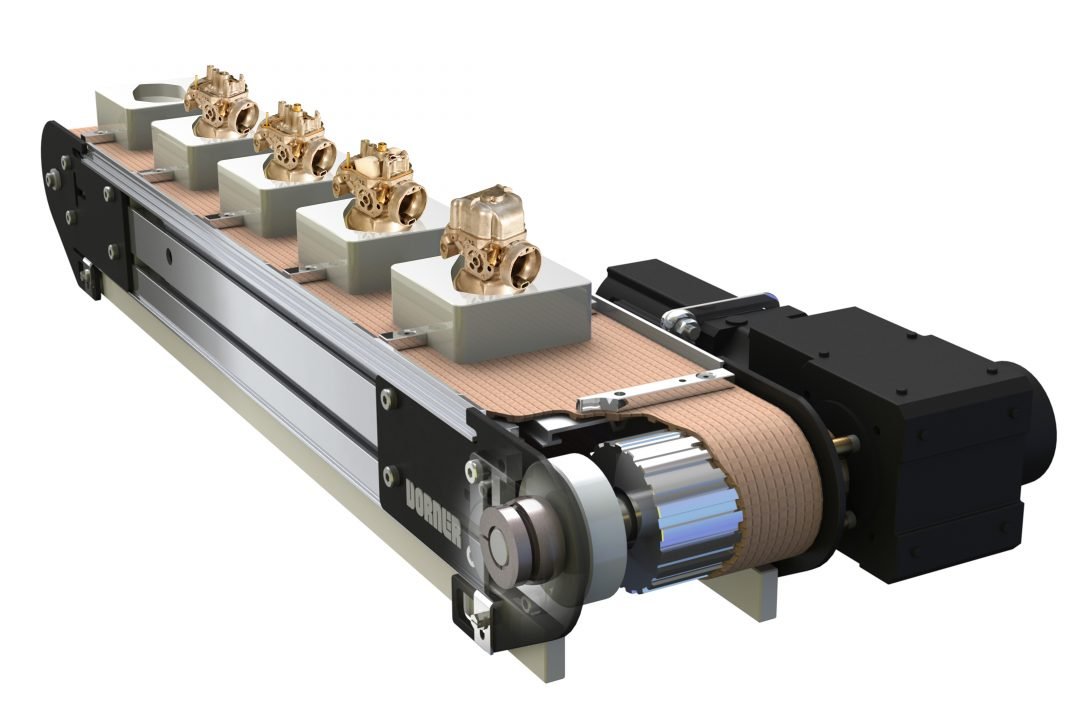
Precision depends on the drive, belt engagement, product fixture and control sequence working together. A positive-drive timing belt can reduce slip, while fixtures or pallets keep the workpiece from moving independently of the belt. Transfers and stops must preserve that reference before the next process begins.
- Define accuracy at the process point
- Include acceleration and deceleration in product tests
- Verify fixture, guide and stop repeatability
- Measure the complete cycle rather than unloaded belt travel