01
Practical overview
The landscape of modern warehousing has undergone a remarkable transformation since the first conveyor belt systems revolutionized material handling operations decades ago. What began as a simple innovation has evolved into sophisticated automated systems that form the critical infrastructure of today’s high-performing warehouses. In an era where efficiency is currency, automated conveyor systems have emerged as the backbone of warehouse automation, enabling facilities to meet ever-increasing demands while overcoming persistent challenges.
The following sections will demonstrate how the right conveyor solutions, properly implemented, can become your warehouse’s most valuable productivity asset.
02
The Current State of Warehouse Automation
Today’s warehouse operators face mounting pressures: labor shortages that show no signs of abating, supply chain disruptions that demand greater operational resilience, and consumer expectations for faster fulfillment than ever before. Some of the most common challenges include:
The warehousing industry continues to grapple with a persistent labor shortage. Facilities are operating with fewer workers than optimal levels, creating significant operational bottlenecks. This workforce gap is compounded by high turnover rates.
Global supply chain volatility has become the new normal. Warehouses must now operate with greater flexibility and resilience to manage unpredictable inventory flows, fluctuating lead times, and sudden demand spikes.
These converging challenges present both significant obstacles and strategic opportunities for today’s warehouse operators. The labor shortage forces facilities to accomplish more with fewer workers, making automation not just a productivity enhancement but an operational necessity.
03
Understanding Automated Conveyor Systems
Automated conveyor systems represent the cornerstone of modern warehouse automation, offering far more functionality than their predecessors. These sophisticated systems serve as the foundation for efficient material flow and enable the integration of advanced technologies throughout the facility.
Today’s warehouse operations can leverage several distinct conveyor technologies, each optimized for specific applications:
Modern automated conveyor systems have evolved significantly, incorporating innovations that enhance performance and flexibility:
Key Features: Low-profile design (as little as 1.85″ height), available in widths from 1.75″ to 24″, configurable for curves and inclines, and load capacity up to 150 lbs
- Belt Conveyors: Versatile systems ideal for transporting a wide variety of products ranging from small items to large packages
- Modular Belt Conveyors: Flexible systems allowing for curves, inclines, and declines while maintaining product stability
- Flexible Chain Conveyors: Space-optimizing systems that can navigate multiple planes with tight turns
- Precision Controls: Modern motor and drive systems enable precise speed control, soft starts/stops, and variable speeds
- Modular Design: Quick-connect components and standardized interfaces allow for rapid reconfiguration
- Smart Sensors: Embedded photoelectric and proximity sensors enable real-time tracking and system responsiveness
- Energy Efficiency: Low-friction materials and zone control systems reduce power consumption
- Reduced Maintenance: Self-lubricating components and predictive maintenance capabilities minimize downtime
04
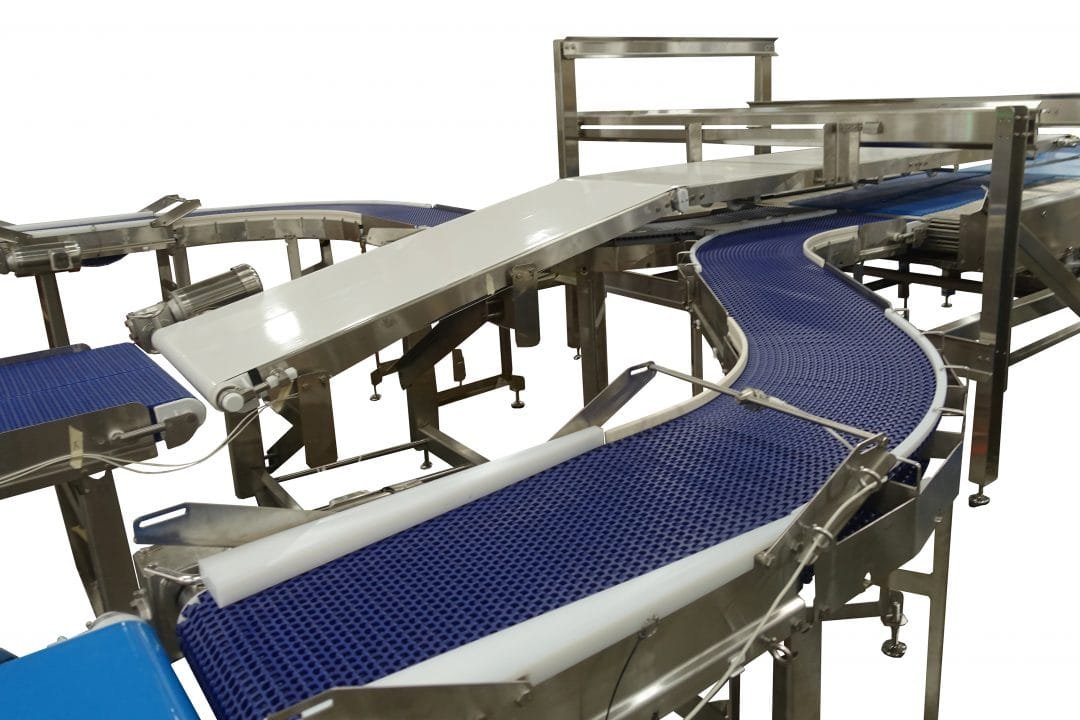
AquaGard & AquaPruf Sanitary Conveyors
Key Features: Positioning accuracy within ±0.02″, available in both 2200 and 3200 Series platforms, and servo motor options for controlled acceleration/deceleration
Key Features: Multiple technologies, including timing belt (DualMove), edge roller (ERT series), flexible chain options, positioning accuracy up to ±0.5mm, and customizable pallet designs
The true value of modern conveyor systems extends beyond simple transport to serve as integration platforms for complementary technologies. Advanced warehouse automation relies on this seamless connectivity between physical conveying and digital control systems.
This connectivity enables real-time tracking, automated sortation, and dynamic routing based on warehouse management system instructions.
- Any environment requiring sanitary standards
- Facilities subject to wash-down procedures
- Precise product positioning and routing
- Electronic and medical device manufacturing
05
Strategic Applications in Warehouse Operations
Automated conveyor systems are more than simple transport mechanisms in today’s warehouses; they are strategic assets that can transform operational capabilities when deployed thoughtfully. By understanding how these systems can be applied to specific warehouse functions, operators can maximize productivity gains and return on investment.
06
Material Handling and Product Flow Optimization
The foundation of warehouse efficiency begins with streamlined product movement throughout the facility. Implementing a well-designed conveyor network creates predictable, consistent flow paths that minimize manual handling and accelerate throughput.
The 2200 Series offers a low-profile solution for facilities with space constraints that can be configured for overhead transport, maximizing usable floor space while maintaining smooth product flow.
07
Order Fulfillment and Picking Processes
E-commerce growth has dramatically increased the importance of efficient order fulfillment. Automated conveyor systems enhance picking operations by delivering products to pickers (goods-to-person) or transporting totes between picking zones.
For high-precision applications requiring exact product positioning for robotic picking, Precision Move conveyors provide repeatable positioning within ±0.02″.
Effective sortation is crucial for accurate order fulfillment and efficient inventory management. Modern conveyor systems employ sophisticated diverting mechanisms to route products to their appropriate destinations automatically.
Balancing production flow in warehouses often requires accumulation zones to buffer products during downstream slowdowns or to prepare for merging operations. Advanced conveyor systems provide controlled accumulation that prevents product damage while maintaining throughput.