01
Practical overview
Conveyors are a common sight on the manufacturing floor to move product from one operation step to the next. It’s easy to see the large mainline conveyance systems that move product throughout a sprawling warehouse, but one unseen area where conveyors have proven to be a vital asset is integration within or through other mechanisms.
When conveyors integrate into larger machines, that system must work cohesively to maintain efficient and accurate product throughput. From parts machining and assembly to packaging and labeling, conveyors are integrated with various equipment, making it difficult to know which conveyor is ideal for your unique application.
Knowing the integrated system’s unique requirements and the desired result is critical to selecting the best conveyor for your integrated machine.
02
What step in the manufacturing process does the machine perform?
Consider the machine’s process within the production line and how the conveyor will play a part.
For example, a packaging application may require product to be precisely positioned inside the packaging or palletized and wrapped for shipment. In this case, a conveyor with high precision and variable speed controls is necessary. Conversely, in an inspection application, product may need to be moved through the inspection area steadily to be scanned by photo sensors or a metal detector. This application may not require the conveyor to start and stop for product positioning, but it will need specialty belts or metal-free sections to facilitate accurate inspection.
Every machine performs a unique function in manufacturing, which can affect any aspect of the conveyor selection, from the type of belting used to the frame material and customized modules. Starting your search here can help narrow down which conveyor system options you must choose from and simplify the customization process.
Your product is the next element to look at when selecting the right conveyor for machine integration. Considering weight, size, and material, the product can help determine the ideal conveyor system.
03
What is the size of the space the conveyor must fit into?
Machine integration is all about ensuring a conveyor can effectively interface with equipment to perform the necessary task within the manufacturing line. Conveyors must be low-profile and flexible to fit within and around machinery while still effectively transporting material. Conveyor engineers and integration specialists will use the size of a product and the machine’s working space to select the right conveyor system or design a custom solution for your application.
04
What maintenance needs to be performed?
Depending on the areas accessible by operators, the conveyor may require specific mounting brackets, stands, or belting. For example, if somebody can only access the ends of the conveyor for routine belt changes, the belt will need a plastic or metal clipper-type splice rather than the typical continuous splice.
05
Ideal Conveyors for Machine Integration
Each system provides a high degree of accuracy and repeatability over time, ensuring that product quality maintains throughout the life of the conveyor.
This conveyor is ideal for mounting inside larger machines for a completely integrated production application. This system also has backlit capabilities for visual systems and other inspection processes.
This system offers a durable, anodized aluminum frame with a wide selection of belts to meet the needs of your application. 2200 series conveyors can be integrated within larger machinery or utilized to transfer product between steps in the manufacturing process.
These conveyors can be configured with multiple curves and inclines on the same line, helping to reduce the system’s footprint while maintaining precise product movement throughout the manufacturing line and through larger machinery as needed.
- Drive pulley diameter as small as 25 mm (1″)
- Idler pulley diameter as small as 16 mm (0.625″)
- 8 mm (0.31″) optional nose bar for tight transfers
- Widths: 44 mm (1.75″), 95 mm (3.75″), 152 mm (6″), 203 mm (8″), & 254mm (10″)
- Flat Belt End Drive, Cleated Belt End Drive, Center Drive, Drive, and Gravity Roller models
- Chain types: low friction, friction insert, conductive, cleated, roller top, magnetic top, and more!
- Standard widths: 45mm, 65mm, 85mm, 105mm, 150mm, 180mm, & 260 mm
06
AquaGard LP Sanitary Stainless-Steel Conveyors
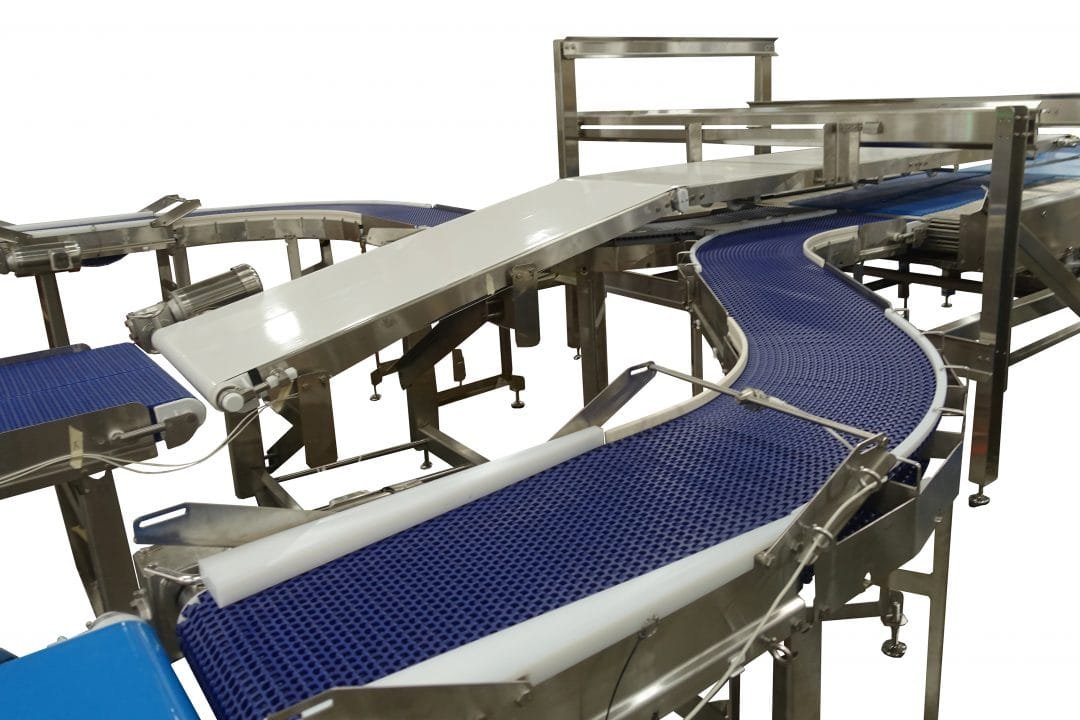
The low frame height and small diameter rollers allow this conveyor to easily integrate within larger systems for numerous applications including food production, inspection, and pharmaceutical manufacturing.
- Tip-up tails for access inside the conveyor for cleaning and maintenance
- 32 mm (1.25”) diameter roller and drive pulleys
- 38 mm (1.5”) bottom of the frame to top of the belt
- Lengths from 500 mm to 5485 mm (19.7”-18’)
07
Custom Engineered Conveyors for Your Application
Choosing the right conveyor is vital when integrating with other machinery, and there can be many factors to consider.