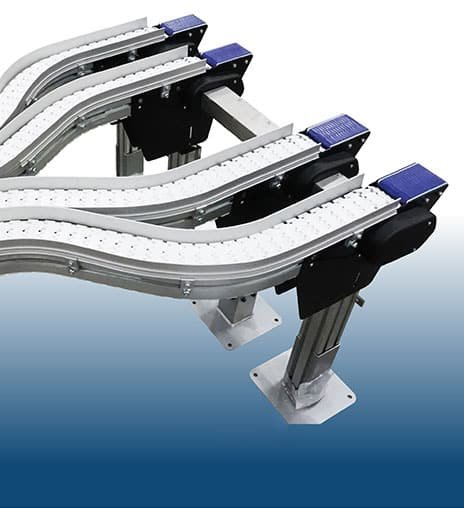
01
Practical overview
In today’s fast-paced manufacturing and packaging environments, maintaining efficient product flow is critical to maximizing throughput and minimizing downtime. Accumulation conveyors serve as essential buffer zones that ensure production lines continue to run smoothly even when bottlenecks occur. This comprehensive guide explores how strategic accumulation solutions can transform your operation’s efficiency and deliver significant return on investment.
02
What Are Accumulation Conveyors and Why Are They Critical?
Accumulation conveyors are specialized material handling systems designed to temporarily hold products in a controlled manner, creating a buffer between different production processes. Unlike standard conveyor belts that simply transport items from point A to point B, accumulation conveyors intelligently manage product flow to accommodate variations in upstream and downstream processes.
These systems become essential in scenarios where:
- Different production stages operate at varying speeds
- Equipment requires maintenance or experiences temporary stoppages
- Product inspection or quality control processes create bottlenecks
- Packaging operations need consistent product supply despite upstream fluctuations
- Line constraints threaten overall production efficiency
03
Key Benefits of Implementing Strategic Accumulation Equipment
Implementing the right accumulation system delivers substantial benefits to your production line:
Accumulation solutions can increase throughput by ensuring your constraint operations remain running even during temporary slowdowns elsewhere in the line. This productivity boost directly translates to improved production capacity and revenue potential.
By keeping your constraint running, accumulation systems maximize overall line uptime and efficiency. This is particularly valuable for high-volume production facilities where every minute of downtime represents significant lost revenue.
One of the most important features of modern accumulation systems is zero backpressure technology, which eliminates product and label damage during accumulation. This preservation of product integrity is crucial for delicate items, premium packaging, or products with precise labeling requirements.
04
Specialized Accumulation Solutions for Diverse Applications
Engineered specifically to provide low-friction accumulation, these systems excel at recirculating assembly components in industrial manufacturing settings.
The BiFlo system implements a clever design with dual opposing conveyors that work in harmony to effectively recirculate products during wait times between production phases. The system’s specially designed diverting mechanisms guide products efficiently toward the central area, with manual adjustment options to redirect products to outfeeds when production demands change.
These intelligent accumulators enhance production synchronization by ensuring downstream operations receive a consistent, well-organized product flow.
- The system delivers multiple operational advantages:
- Advanced pressure management technology that protects product integrity
- Streamlined engineering that reduces maintenance complexity and operational costs
- Versatile lane management capabilities for production flexibility
- Engineering that minimizes surface friction and operational noise levels
- Multi-functional capabilities such as single file or lane divide
05
Pharmaceutical Vial & Bottle Accumulation
The pharmaceutical-specific design incorporates several key advantages:
The FlexMove Helix system represents an engineering breakthrough, combining compact design with flexible configuration options for efficient buffering in limited spaces. The innovative side roller chain technology reduces corner friction, enabling higher operational speeds and gentler product handling while maintaining adaptability to diverse application requirements.
This vertically-oriented system offers expanded configuration flexibility with customizable infeed and outfeed sections that extend beyond the main spiral. This intelligent design reduces the total number of required conveyors while simplifying system integration. The flexible positioning capabilities for both infeed and outfeed components allow placement at various heights and angles, creating seamless integration with existing production systems.
Common applications for this space-efficient solution include:
- Reduced drive component count that simplifies maintenance and increases reliability
- Optimized energy consumption for sustainable operation
- Maximized production uptime through consistent product flow
- First-in-first-out handling that maintains product sequence integrity
- Flexible lane management for production adaptability
- Exceptional return on capital investment
- Proven performance metrics in pharmaceutical environments
- Dynamic flow division capabilities for production flexibility
06
Advanced Accumulation Technology: What Sets Intelligent Motion Systems Apart
Backpressure can cause damage and collisions.
On most accumulation systems, all lanes run at the same speed, causing products to become nested, which means they must be de-nested at the pickoff point.
Quality accumulators are designed to meet the strictest industry regulations for safety and integrity. This includes reduction of areas where foreign materials can collect, minimized no metal-to-metal surfaces to eliminate entrapment, and easy to clean surfaces to meet FDA standards.
Before deciding on any solutions, a conveyance expert will meet with you to perform a free line analysis and find the best possible accumulation solution for your line.
07
Strategic Selection: Choosing the Right Accumulation Solution
Selecting the optimal accumulation system requires thorough evaluation of your specific production requirements. Consider these critical factors:
Together, weidentify specific needs and determine how to best increase your throughput. These accumulation solutions range from small-footprint bi-flo tables to complex distribution systems, and are custom engineered to solve industry challenges including pharmaceutical handling, beverage packaging, food processing, packaging, and more.
- Dimensions, shapes, and weight profiles
- Stability concerns (tendency to tip or fall)
- Surface finish requirements (susceptibility to marring)
- Product format variations throughout production
- Throughput requirements and line speeds
- Integration requirements with existing equipment
- Process variability between upstream and downstream operations
- Changeover frequency and flexibility needs