01
Application context
Effective product transfers ensure quality, efficiency, and safety in any production line. Whether a product needs to be transferred from one conveyor line to another or from machine to conveyor and onto the next processing step, designing the transfer method around your product and operation is critical to reducing waste, backups, and downtime.
The transfer method can vary widely depending on the product and process being performed.
- Handles a wide range of product sizes and shapes
- There is a small gap between conveyors
- Conveyors must match profiles to transfer products effectively
- It is not ideal for very small products or parts
02
Design considerations
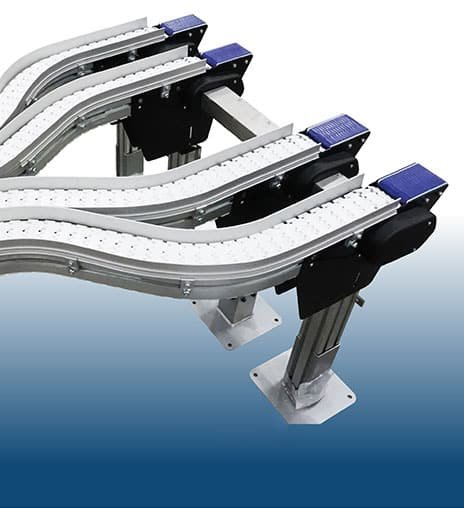
Also called an end-to-end transfer, this method is when the roller or drive end of a conveyor butts up against the next conveyor, forming a straight line from one belt to the next. While this is one of the most straightforward transfers, it still requires careful planning to ensure both conveyor profiles match to reduce the potential for the product to fall between the two conveyors.
In an inline transfer, there is typically a small gap between the two conveyor ends, so this method may not be ideal for tiny or flexible parts that may fall through the space.
- Simple and cost-effective method of bridging gap between conveyors
- Ideal option for products with low stability
- Guiding is recommended to ensure no product loss during transfer
- Not ideal for low-capacity production lines