01
Practical overview
Industrial conveyor systems have become an indispensable part of manufacturing automation, serving as the backbone for many modern production lines. From heavy-duty conveyors handling bulk materials to precision systems for delicate items, today’s conveyors are more advanced and versatile than ever. Whether you’re producing automotive components or packaging consumer goods, a well-integrated conveyor solution can pave the way for production line optimization and enhanced operational efficiency.
Manufacturers face increasing pressure to produce higher volumes at faster speeds while keeping costs manageable. This pressure, coupled with the rise of industrial automation trends, has accelerated the need for conveyor systems that not only move products but also streamline workflow, reduce manual labor, and maintain consistent quality.
02
The Role of Industrial Conveyor Systems
Modern conveyors go beyond simple transportation. They enable:
- Precise movement of parts to the right location at the right time.
- Real-time data tracking for quality control and throughput analytics.
- Scalable flexibility, allowing reconfiguration as needs shift or production lines expand.
03
Types of Industrial Conveyor Systems and Their Functions
Belt conveyors feature continuous loops made of fabric or modular belts that move products from one point to another:
Roller conveyors employ cylindrical rollers to transport items and can be powered or gravity-driven:
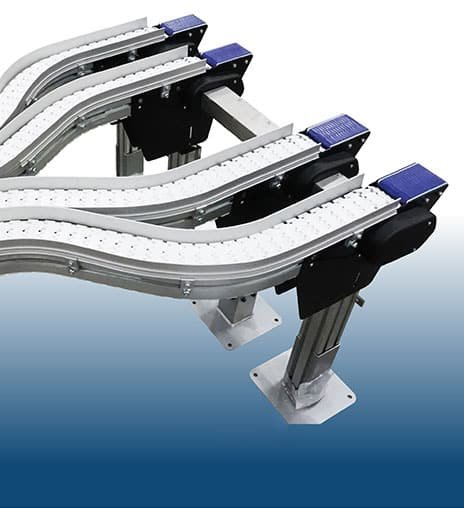
Flexible chain conveyors are similar to modular belt conveyors but unlike the mesh-style linking of modular belt components, flexible chain conveyors use a unique single-point link maximizing 3-dimensional flexibility. This unique feature makes these conveyors ideal for complex configurations with multiple curves and elevation changes on a single line.
Overhead conveyors free up valuable floor space by moving products along elevated tracks:
- Common Use Cases: Packaging, assembly lines, inspection stations.
- Advantages: Smooth material flow, adaptability for inclines/declines, efficient conveyor integration.
- Key Consideration: Proper tracking and tensioning to maintain performance.
- Ideal For: Cartons, pallets, or other flat-bottomed products.
- Benefits: Low maintenance, ease of installation, scalable configurations.
- Drawback: Not as suitable for smaller or irregularly shaped items without additional guiding.
- Where They Shine: Large or oddly shaped products, space-constrained layouts.
- Distinct Advantages: Adaptable routing, sturdy construction for heavy-duty conveyors.
04
Major Industries Adopting Industrial Conveyor Systems
In automotive plants, conveyors must handle parts of various sizes and weights with precision:
Electronics manufacturing demands gentle handling and static-safe conditions:
Packaging lines often run at high speeds, requiring conveyors to transfer products seamlessly to labeling, sealing, or palletizing stations:
Rapid order fulfillment and sorting are essential in online retail, necessitating conveyor systems that seamlessly integrate with advanced technologies.
- Reliability: Automated/robotic assembly, sensitive battery assemblies for EVs, and more.
- Advantages: Precise scheduling in assembly lines, reduced manual handling.
- Key Focus: Durability and production line optimization.
- Typical Products: Printed circuit boards (PCBs), microprocessors.
- Conveyor Must-Haves: ESD protection, minimal vibration, accurate positioning.
- Benefit: High reliability for delicate components.
- Critical Needs: Rapid throughput, minimal downtime, easy changeovers for different package sizes.
- ROI Factor: Efficient conveyor integration with automated pack-off stations.
05
Optimizing Production Flow with Conveyor Technology
One of the most significant challenges in any production environment is managing bottlenecks—those critical points where products pile up or slow down the entire line. By strategically placing conveyor systems and aligning them with your overall manufacturing process, you can:
In addition, conveyors often come equipped with control features that monitor throughput and automatically adjust speeds to match production demands. This ensures every part of the assembly line operates at optimal capacity, minimizing waste and preventing backups.
Modern manufacturing frequently involves robots, pick-and-place machines, and automated guided vehicles (AGVs). Conveyors serve as the connective tissue for these systems, helping them work in harmony. Key advantages include:
By designing conveyors that integrate seamlessly with your existing or planned robotic setup, you can extend automation’s benefits throughout the production line, boosting consistency and increasing output.
- Streamline Workflow: Automated conveyors continuously move materials and products from one station to the next, reducing idle time between steps.
- Improve Consistency: A stable, repeatable flow means fewer surprises and less downtime. Products don’t sit waiting for the next workstation, which keeps production moving smoothly.
- Balance Workload: When each station receives a consistent supply of parts, teams or automated machines can focus on their tasks without interruptions. This steady cadence allows managers to quickly identify and address any emerging slow spots.
- Enhanced Precision: Coordinating conveyor movement with robotic arms ensures each product reaches the robot’s workspace in a predictable manner, enabling precise picking, placing, or assembly.
- Real-Time Adjustments: Advanced conveyors can receive signals from sensors or a Manufacturing Execution System (MES) to speed up or slow down based on changing throughput requirements, ensuring you meet production targets with minimal downtime.
- Reduced Labor Costs: Automating tedious or repetitive tasks frees up operators to focus on higher-value responsibilities such as quality control or process improvement.
- Lower Risk of Injuries: By reducing the need for heavy lifting, manual handling, or repetitive motions, conveyors help prevent common workplace injuries like muscle strains and back pain.
- Built-In Safety Measures: Guardrails, emergency stops, and sensor-based safety systems can detect jams or blockages and automatically halt the conveyor to prevent accidents.
06
Reducing Downtime & Boosting Throughput
Regular inspections and scheduled part replacements ensure peak performance:
- Focus Areas: Belt tension, motor bearings, sensor calibration.
- Benefit: Minimizes unexpected halts in production.
- Industry Challenge: Meeting high output demands without compromising on quality.
07
Real-Time Monitoring & Troubleshooting
Industrial conveyors have continually evolved to meet the growing demands of modern manufacturing. As industrial automation trends push the boundaries of speed, efficiency, and data-driven operations, conveyor technology is evolving in exciting new ways. Below are the key trends set to define the next wave of conveyor innovation.
- Instant Alerts: Flag misalignments or motor inefficiencies early.
- Proactive Resolutions: Maintenance teams can address issues before major disruptions occur.
- Real-Time Monitoring: Conveyor systems equipped with sensors, smart controllers, and IoT devices can track operational metrics—such as motor temperatures, belt speeds, and throughput—in real time. This enables instant adjustments and swift resolution of any emerging issues.
- Predictive Maintenance: By analyzing sensor data, manufacturers can identify when components are nearing failure. Instead of reacting to sudden breakdowns, teams can plan maintenance schedules that minimize downtime, increasing production line optimization.
- Enhanced Connectivity: Seamless communication between conveyors, robotic stations, and a central Manufacturing Execution System (MES) boosts overall operational efficiency. Managers can monitor all parts of the process from a single dashboard, ensuring that production goals are consistently met.