01
Practical overview
In modern manufacturing, maximizing production efficiency while minimizing downtime is crucial for maintaining a competitive advantage and meeting customer demand. But how exactly do accumulation conveyors improve assembly line throughput?
Accumulation conveyors improve assembly line throughput by creating buffer zones that prevent line stoppages, allowing continuous production flow even when individual workstations experience brief delays or interruptions, typically increasing efficiency by 15-30%.
While this basic explanation covers the fundamental benefit, it’s important to understand that different types of accumulation conveyors offer varying advantages depending on your specific manufacturing setup and production goals. Knowing which type best suits your needs could make the difference between a modest improvement and a dramatic boost in productivity.
Accumulation conveyors are specialized material handling systems designed to temporarily store products between different stages of production. Unlike standard conveyors that move products at a constant speed, accumulation systems can slow down, stop, or create temporary storage zones without halting the entire production line.
02
The Problem: Micro-Stops and Speed Variations
Micro-stops are brief interruptions lasting seconds to minutes that occur throughout assembly lines. Common causes include:
While individually small, these micro-stops can cascade through an assembly line, creating significant throughput losses when stations are rigidly connected.
Different manufacturing processes naturally operate at varying speeds:
Without proper buffering, the entire line must operate at the speed of the slowest station, severely limiting overall productivity.
- Quality inspections that require temporary product holds
- Tool changes or minor adjustments at workstations
- Material replenishment at individual stations
- Equipment calibration or minor maintenance tasks
- Line backups due to slower machine throughput in downstream processes
- Manual assembly stations may have natural human pace variations
- Automated processes might run at different cycle times
- Quality control checkpoints require variable inspection times
03
How Accumulation Conveyors Solve These Problems
Accumulation conveyors create intelligent buffer zones between production stations. When a downstream process slows down or stops temporarily, products accumulate in these buffer zones rather than backing up the entire line. This allows upstream processes to continue operating at optimal speeds.
By implementing accumulation zones, manufacturers can decouple the speeds of different production stages. This means:
- Upstream stations maintain productivity during downstream delays
- Better utilization of equipment and labor
- Fast processes aren’t held back by slower operations
- Slow processes aren’t overwhelmed by faster upstream production
- Each station can operate at its optimal efficiency level
- Overall line speed increases significantly
04
3. Absorbing Variation and Maintaining Flow
Accumulation systems act like shock absorbers for production variations:
- Temporary slowdowns are absorbed without affecting the entire line
- Speed bursts from efficient operations are captured and smoothed out
- Maintenance windows at individual stations don’t halt production
- Quality holds affect only the specific products, not the entire flow
05
Types of Accumulation Conveyor Systems
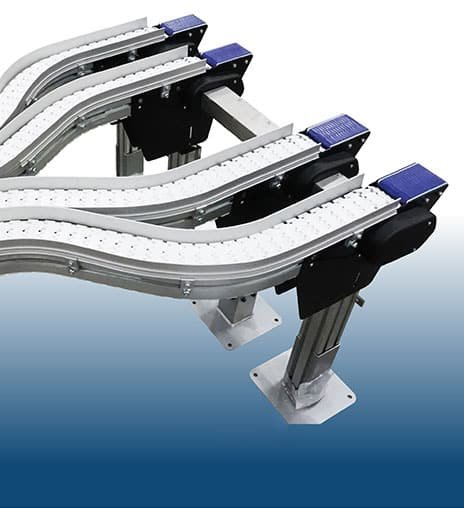
Modular belt accumulation systems offer flexibility and can handle various product types while providing smooth accumulation and release.
When implementing accumulation conveyors, manufacturers should track:
Overall Equipment Effectiveness (OEE):
Many manufacturers report significant improvements after implementing accumulation systems:
- Gentle product handling ideal for medical applications
- Easy integration with existing systems
- Suitable for fragile or delicate items
- Suitable for food and pharmaceutical applications
- Availability improvements from reduced line stops
- Performance gains from speed optimization
- Quality maintenance through controlled handling
- Enhanced production scheduling flexibility
06
Choosing the Right Accumulation Solution
When selecting accumulation conveyor systems:
FlexMove Systems provides flexible accumulation with:
Modern accumulation conveyors increasingly incorporate:
Accumulation systems are becoming key components of smart manufacturing alolng with:
- Size, weight, and fragility requirements
- Surface finish and contamination concerns
- Temperature and environmental considerations
- Throughput targets and variation patterns
- Available floor space and layout constraints
- Maintenance accessibility and requirements
- Space-saving vertical accumulation & buffering solutions
- Flexible & customizable layout designs
07
Maximizing Your Accumulation Investment
To achieve maximum throughput improvements:
Accumulation conveyors represent a proven strategy for dramatically improving assembly line throughput by creating intelligent buffers that absorb micro-stops and speed variations. With typical throughput improvements of 15-30%, these systems offer some of the highest ROI and productivity enhancements available to manufacturers.
For manufacturers looking to optimize assembly line performance, properly designed accumulation systems offer a clear path to improved efficiency, reduced downtime, and enhanced profitability. The key is working with experienced conveyor specialists who can design solutions tailored to your specific production requirements.
- Conduct a thorough line analysis to identify optimal accumulation points
- Size buffers appropriately based on actual production data
- Train operators on system capabilities and optimization techniques
- Monitor performance metrics continuously for ongoing improvement
- Maintain systems properly to ensure consistent operation
- Targeting high-impact locations for accumulation installation
- Optimizing control strategies for your specific production patterns
- Regular performance reviews to identify additional opportunities