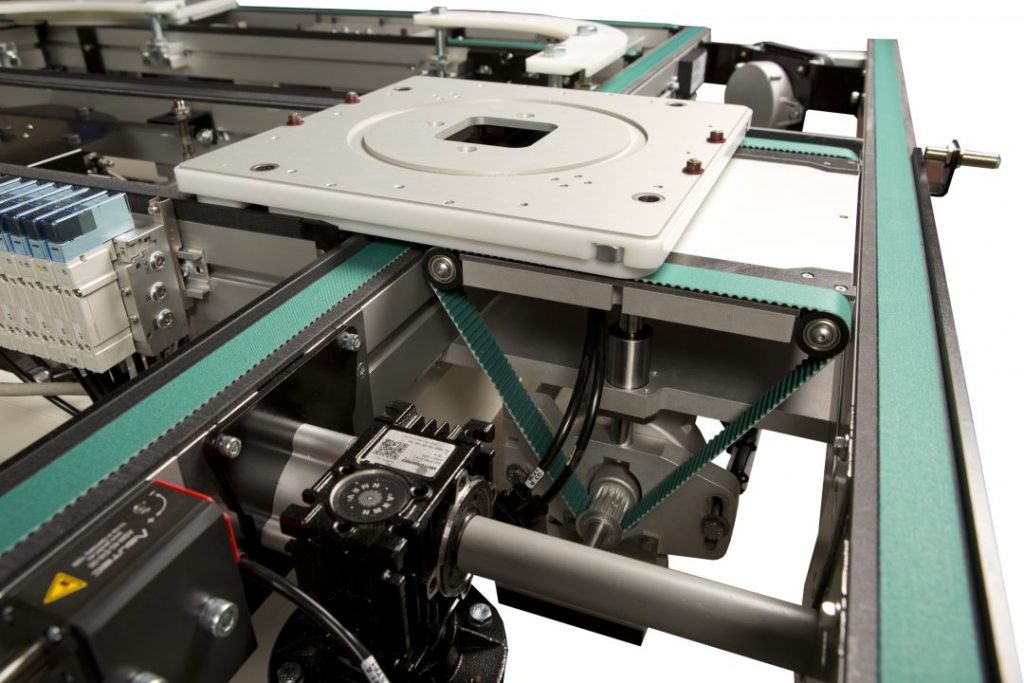
Equipment and operating figures
Figures describe the configuration and operating conditions in this case.
- Lines
- 2
- Platform
- 2200 Series Precision Move pallet system
- Stations
- Lift-and-locate units
- Corners
- 90-degree pin-tracking arrangement
- Source module rotation
- Adjustable 90–180 degrees with cushioned lift stroke
- Lift-and-transfer capacity described
- 50 pounds
- Pallets with custom fixtures
- Approximately 45 pounds
The process sequence
- Locate the pallet at a station
- Perform manual or automated work
- Check quality before transfer
- Maintain pallet orientation through corners
- Change fixtures or add stations when required
Moving the work without making people follow it
The earlier wiring-harness process used travelling pinboards. Each person walked beside the moving part to complete a task and then returned to the starting position. Finished harnesses were checked only at the end of the process.
The producer wanted better quality and throughput, quicker changeovers and more comfortable work positions. The installation schedule was also compressed, making a modular arrangement attractive.
Pallet location and quality checks at each stage
Two manufacturing lines used a 2200 Series Precision Move pallet arrangement with lift-and-locate stations and ninety-degree pin-tracking corners.
At the work stations, pallets were held in a repeatable location so people could perform their tasks without walking along the conveyor. The same positioning supported automated operations beside the manual work.
Quality control was included at the assembly stations. If a part failed, it could be corrected or discarded there rather than receiving the remaining work before a final rejection. That avoided carrying a known defect through the entire process.
Orientation, modules and changeover
The pin-tracking corners maintained the pallet's leading-edge orientation with little additional guiding, avoiding the extra drives or more complicated modules otherwise needed for that transition.
The source also illustrates a module with an adjustable ninety-to-180-degree rotation range and a cushioned lift stroke, and a lift-and-transfer module with a fifty-pound load capacity. These descriptions concern their respective modules and should not be treated as the same rating.
Standard pallets fitted with custom fixtures weighed about forty-five pounds. Fixtures could be changed as the product changed without replacing the base conveyor. Additional stations and conveyor sections could be added when higher throughput was required.
Documented implementation
The account reports that the lines were brought into operation on schedule.
Its documented contribution is the new work method: fixed operator positions, repeatable pallet location, checks during assembly and a modular path for fixture changes and future expansion.