Equipment and operating figures
Figures describe the configuration and operating conditions in this case.
- Platform
- 3200 Series precision timing-belt conveyors
- Published movement accuracy
- ±0.02 inches
- Published indexing rate
- Up to 100 indexes per minute
- Fixture attachment location
- ±0.005 inches
- Side-guide tolerance
- ±0.01 inches
The process sequence
- Feed inner and outer tumblers
- Index on timing-belt conveyors
- Locate fixtures and guide products
- Load robotic cell
- Process the drinkware
Growth and a phased approach to automation
The application involved double-wall insulated plastic drinkware, with separate inner and outer tumblers that had to be brought into robotic processing cells. A growing range of sizes and customised designs made reliable product presentation particularly important.
The producer had expanded its production floor area by more than sixty percent and its workforce by forty percent. Rather than automate the whole factory at once, it chose a phased programme focused on repetitive operations that did not require a human touch.
That strategy made conveyor repeatability part of the machine specification. A robot can only perform its intended operation reliably if the incoming components arrive where the cell expects them.
Precision transport within the robotic machine
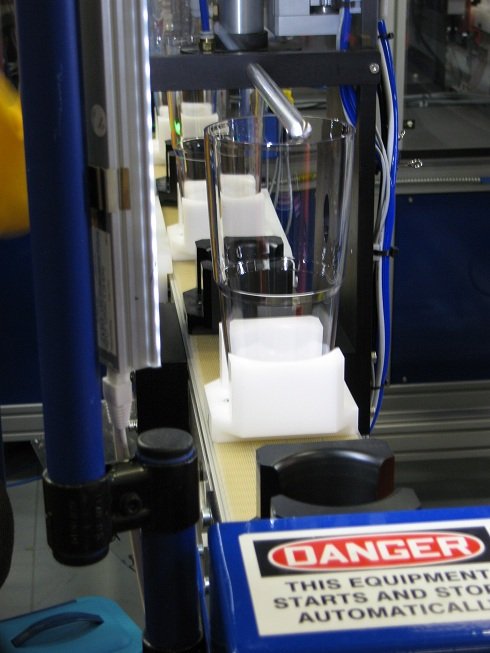
A series of 3200 Series conveyors with timing-belt technology carried inner and outer tumblers into the cells. This type of positive belt drive supports indexed movement, common-drive arrangements, positioning and loaded belt applications within assembly or packaging machinery.
The published conveyor package specified movement accuracy of ±0.02 inches at rates up to one hundred indexes per minute. A flexible fixture-attachment system located fixtures to ±0.005 inches, while side guides held a ±0.01-inch side-to-side tolerance for loading, unloading and assembly positioning.
Those are distinct aspects of the package. Fixture location, lateral guidance and belt movement should not be treated as interchangeable accuracy figures or as a blanket tolerance for the complete robotic machine.
From a prototype to additional cells
A prototype was built and evaluated before the producer ordered several more machines. The reported productivity improvement in that first machine supported the decision to expand the installation.
The account expected the additional machines, once fully operational, to process a substantial part of the product range while reducing cycle times and production footprint.
Application photographs