Equipment and operating figures
Figures describe the configuration and operating conditions in this case.
- Conveyor
- 3200 Series Precision Move
- Actual operating speed
- About 1 inch/second
- Curing travel
- About 1 minute before unloading
- Local loading accuracy
- ±0.002 inches, improved from ±0.02 inches
- Smallest fixture mandrel
- 0.043 inches diameter
- Reported production
- About 60 parts/minute; more than double the former rate
- Source platform ratings
- ±0.02 inches movement accuracy; up to 200 pounds; up to 370 feet/minute
The process sequence
- Feed a connector to its fixture
- Index to the print station
- Apply two colour stripes
- Carry the part through curing
- Grip and unload the dry connector
Replacing an inconsistent marking method
Butt-splice connectors join wire ends without overlapping them. Their small size made them difficult to hold and position reliably during colour marking.
The earlier process collected connectors in a vibratory bowl, moved them along a linear feeder and pushed them onto a rotating spindle. Colour was applied through a felt-marker arrangement, after which the spindle withdrew and the part dropped into a bin. The producer wanted more consistent marking and a faster process.
The replacement required indexed rather than continuous travel, fixtures fixed at predetermined positions on the belt, and a conveyor that could be integrated without designing the entire transport mechanism from scratch. Motor sizing, electronic controls and the mechanical interfaces were developed together.
Mark and cure while the part remains located
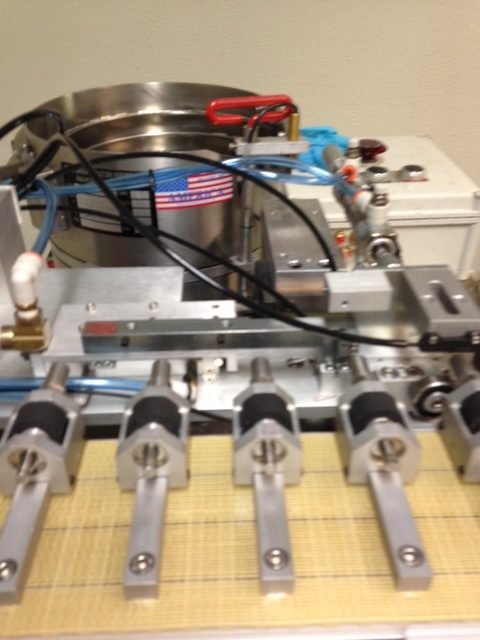
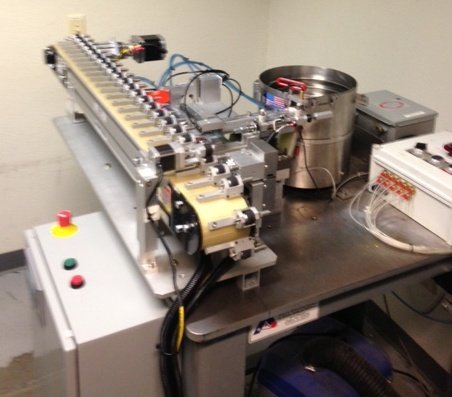
A 3200 Series Precision Move timing-belt conveyor carried fixture mounts between process positions. A connector was loaded onto its tooling mandrel, indexed to the print section and marked while still held on the same fixture.
The conveyor then carried it around the available path for about one minute so the colour could cure before grippers removed the part and dropped it into a collection container. Keeping it on the fixture until dry reduced the opportunity to smear the finish.
The redesigned equipment could apply two stripes at the same time, produced brighter and more consistent colours, and avoided the consumable felt-tip markers used previously. Multiple indexing locations provided useful curing travel without relying on a cam indexer with fewer available stations.
Extra accuracy at the critical loading station
The source-era conveyor description gave a movement accuracy of ±0.02 inches, load capacity up to two hundred pounds and speed capability up to 370 feet per minute. In this process it actually ran much more slowly, at about one inch per second.
The smallest mandrel was just 0.043 inches in diameter, so ±0.02 inches was too coarse for the loading task. A fibre-optic area sensor detected the approaching leading edge of a fixture mount. Combined with a stepper-motor drive, it enabled positioning of ±0.002 inches at that station.
That tenfold improvement was achieved by the added sensing-and-drive arrangement at one critical location. It is not a replacement for the published conveyor-wide accuracy figure or a claim that every standard Precision Move installation automatically achieves it.
Production, changeover and operating control
The integrated machine and conveyor more than doubled the previous production rate, reaching about sixty coloured connectors per minute. Quick-change tooling made colour changes easier.
The account also describes more robust equipment and improved logic for recognising process problems. Holding the connector through curing reduced smearing before the next handling step. A conveyor built to the required dimensions and delivered assembled reduced the need for additional custom fabrication.
These results cover the full machine, tooling, sensing and controls. They should not be attributed solely to belt speed or to a conveyor specification taken out of its application context.
Application photographs