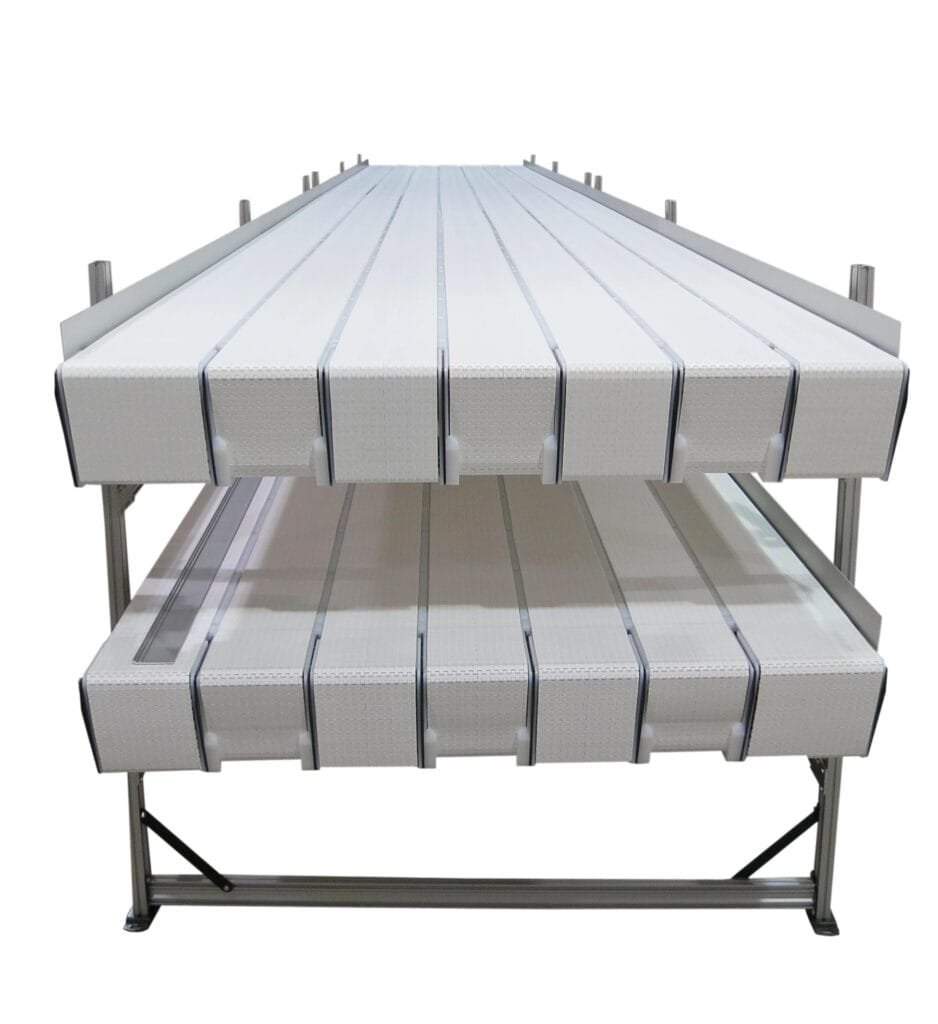
Equipment and operating figures
Figures describe the configuration and operating conditions in this case.
- Platforms
- 2 × 2200 Series conveyors in one frame
- Arrangement
- Slightly offset, with about 1 foot between levels
- Handling
- Robot loading and manual inspection
- Control
- Photo-eyes, indexing signals and indicator light
- Later extension
- Related 3-tier systems subsequently adopted
The process sequence
- Robot places a group on the lower belt
- All-clear signal permits indexing
- Lower level fills
- Operator unloads while robot fills upper level
- Timed empty check
- Photo-eyes release the level for reuse
Balancing robot output with manual inspection
The contract-manufacturing operation used a pick-and-place robot to remove plastic parts from an injection mould. An operator then inspected each part before it entered the next production stage.
Floor space was limited, and the operator needed enough buffered product to work effectively without holding up the robot. A vertical arrangement could create that buffer without using the footprint of two separate conveyor lines.
A shared frame with two working levels
Two 2200 Series conveyors were stacked in a single frame, slightly offset and separated by about one foot. The robot first placed parts on the lower conveyor.
After each placement, the conveyor waited for an all-clear signal from the robot before indexing forward to make room for the next group. When the lower level reached its loading limit, an indicator told the operator to begin unloading it while the robot switched to the upper conveyor.
The timing was important: the conveyor did not simply move continuously underneath the robot. Each movement created the next placement space after the robot had cleared the area.
Unloading, empty confirmation and repeat operation
As the operator removed a group for inspection, the unloading conveyor indexed to present the next group. After the final group was taken, that belt ran for a defined period to ensure it was genuinely empty.
Photo-eyes then signalled that the level was ready for the robot to begin loading again. The alternating process could continue as long as the robot had parts to deliver and the operator continued removing them.
This coordinated buffer separated the robot's immediate placement requirement from the time needed for individual inspection while still checking the state of each conveyor level.
Reported benefit and subsequent development
The engineering account reports improved use of operator time, higher output and lower overall cost, without publishing numerical comparisons. It later records that related three-tier arrangements were adopted as well.
That later extension is distinct from the two-tier sequence described here. The core application principle remains vertical buffering with coordinated robot clearance, indexed presentation and confirmation that a level is empty before reloading.