Equipment and operating figures
Figures describe the configuration and operating conditions in this case.
- Incline conveyor
- 4 feet long at 25 degrees; higher-friction belt
- Packout conveyor
- 7 feet long; low-friction belt and end stop
- Adjustment
- Height-adjustable conveyors and packing table
- Changeover
- Adjustable guides and reversible centre drive
- Reported packout staffing
- 1 person rather than 2
- Sanitation window
- 1 a.m.–5 a.m., about 4 hours
- Source disassembly claim
- One person, no tools, under 90 seconds for the described platform
The process sequence
- Seal and metal-detect cheese trays
- Raise trays on the inclined belt
- Present oriented packs at a stop
- Inspect under task lighting
- Pack at the attached height-adjustable table
A few inches made a repeated task harder
The cheese-processing operation packed up to 700 product variants for more than thirty private-label brands. On its first tray line, sealed packages passed through metal detection and then onto a large rotating accumulation table.
Two people picked trays from that table and loaded shipping boxes. Both the conveyor and table were slightly too low, making some operators bend and reach repeatedly. Trays could also arrive turned in different directions, adding handling before packing.
When a second line was needed, the aim was to change those physical conditions rather than reproduce the original layout.
Raise the product, then make it easy to retrieve
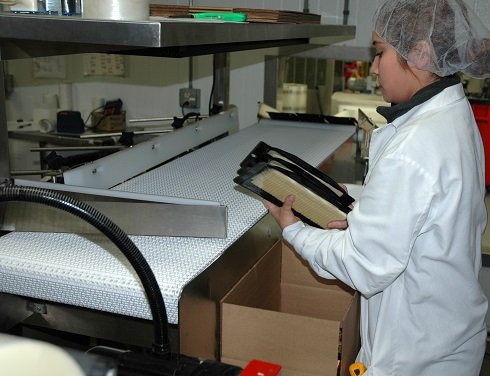
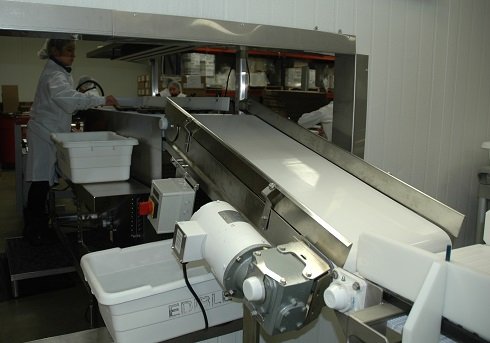
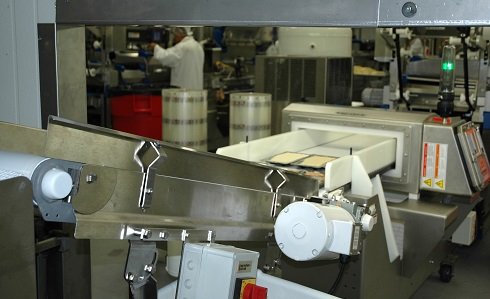
The new arrangement used two sanitary conveyors and an attached packing table, all adjustable in height. After leaving the sealer and metal detector, trays transferred onto a four-foot conveyor rising at twenty-five degrees. A higher-friction belt kept them from sliding back as they were raised to working height.
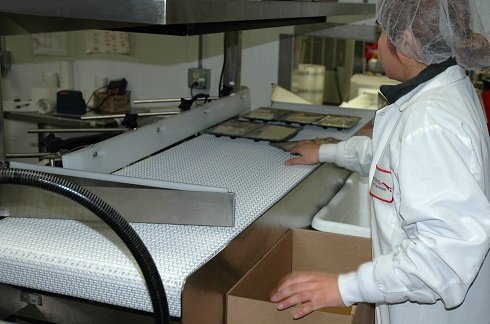
They then moved onto a seven-foot packing conveyor. This belt used lower friction so packs could remain against an end stop while the belt moved beneath them during a backup. The trays reached the operator already oriented, avoiding the twisting and reaching associated with the rotary table.
A shelf with lights above the packout belt improved visibility for inspection. The attached box-packing surface let the operator handle several trays and place them into cartons in a more continuous movement.
Adjustment for operators, formats and future layouts
Installed in autumn 2015, the system could be raised or lowered together with its work table to suit different operators. Conveyor guides adjusted for different tray sizes.
A reversible centre drive allowed the line to be fed from the opposite direction if moved to another area. Those provisions made the arrangement useful beyond a single fixed product and one permanent factory position.
The operator reported that the more efficient packout could be staffed by one person instead of two. This was a result for the complete workstation arrangement; it is not an automatic staffing promise for other lines.
Cleaning within a short overnight window
Production stopped from one to five in the morning for sanitation, giving the crew about four hours to clean the equipment and surrounding operation. Fast access to belt and frame surfaces mattered within that window.
The historical platform description reports tool-free disassembly by one person in less than ninety seconds. Sanitary construction and fast access supported the crew within its limited cleaning window.
For a new application, cleaning access, materials and the sanitation procedure need to be assessed together, just as conveyor height and belt friction were assessed together in this workstation.
Operating experience
The customer reported that the second line was performing well and planned to replace the first tray line with a duplicate design. That plan is retained as a proposed next step, not as confirmation that the later duplicate was installed.
The documented improvements cover reach, product orientation, adjustable working height, format changes, packing effort and access for cleaning. They are more specific than a general statement that a new conveyor increased efficiency.
Application photographs