01
Practical overview
Product damage during conveyor transfers is a significant concern for manufacturers, as it directly impacts bottom-line profitability through waste, rework, and customer dissatisfaction.
The most effective ways to reduce product damage during transfers are maintaining proper belt speeds (typically slower for delicate or unstable products), minimizing transfer gaps (keeping them under the product length), and using appropriate guide rails to control product movement.
While these core principles are universal, the specific approach operators can need depends heavily on your product type, conveyor configuration, and production speed requirements. Discover how to optimize transfer points for your specific situation and learn about advanced solutions for complex transfer scenarios.
02
Understanding Why Products Get Damaged During Transfers
Product damage doesn’t happen randomly, it occurs at predictable points where physical forces exceed a product’s tolerance limits. The most common damage occurs at transfer points and accumulation zones, where products experience sudden changes in velocity, direction, or support conditions.
When products move through conveyor systems, they encounter various forces that can cause damage:
- Impact forces occur when products drop onto surfaces or collide with other items. Even a small drop of 2-3 inches can generate forces equivalent to several times the product’s weight, potentially causing internal damage to electronics or cracking in fragile items.
- Friction forces from rough surfaces or misaligned guides can scratch finishes, tear labels, or create heat that affects temperature-sensitive products.
- Acceleration forces from sudden starts and stops can cause products to shift, tip, or slide, leading to surface damage or complete product failure.
03
Critical Damage Points in Conveyor Systems
Understanding where damage typically occurs helps focus prevention efforts:
The foundation of damage prevention lies in creating conditions where products experience minimal physical stress during movement between conveyor sections.
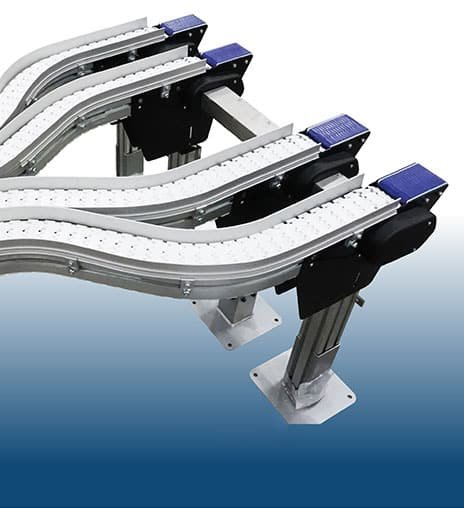
Traditional conveyor designs often feature larger rollers, creating wide gaps at transfer points, which can misalign or drop product. Modern transfer systems utilize small-diameter rollers and offer added nose bar transfers, allowing for small or unstable products to smoothly transfer from one conveyor to another without jostling or shock.
- Transfer zones between conveyors are the highest-risk areas. Sudden changes in speed, direction, or support create opportunities for product impacts and misalignment.
- Elevation changes subject products to gravitational forces that can cause sliding or tipping
- Accumulation areas can create compression forces as products back up during line stops or slowdowns.
- At high speeds, curve sections generate lateral forces that can cause products to shift or collide with guides.
- Reduce impact forces by distributing the transfer load over time
- Maintain product momentum while gradually adjusting to new conveyor conditions
- Prevent sudden jolts that can damage internal components
- Create highway-like merging conditions for seamless product flow
04
Controlling Acceleration and Deceleration
Gradual speed changes prevent products from experiencing sudden forces that can cause damage. This is particularly important for loose items, liquids, or products with moving parts that can shift during transport.
Speed mismatches between adjacent conveyors create impact conditions as products transfer from one section to another. Even small differences can generate significant forces when products repeatedly experience these transitions.
For heavier loads requiring similar precision, 3200 Series heavy-duty conveyors provide the same smooth operation capabilities with increased load capacity.
- Integrated controls solutions offer programmable acceleration curves customized for different product types
- Slower acceleration for light items to prevent sliding
- Gentle speed changes for delicate products
- Consistent velocity maintenance throughout the system
- Consistent momentum maintenance throughout the system
- Reduced stress on both products and equipment
- Careful system design and regular calibration
- Optimal performance through precise speed control
05
Selecting Belt Materials That Protect Products
The belt surface is often the only thing separating your products from potential damage, making material selection crucial for damage prevention.
Different products interact with belt surfaces in unique ways. Smooth, light-weight products such as bottles or plastic parts slide easily across most surfaces, while heavy, textured items may catch on rough belts.
- Smooth surfaces work best for most applications because they minimize friction and reduce the likelihood of product catching or snagging, while also being easy to clean for sanitary applications.
- Textured surfaces provide better traction for inclined transport or in applications where it is crucial for product to remain in place on the belt. However, they should not be used for accumulation, as the added friction can scuff product surfaces, cause excessive heat, and quickly wear out the belt and drive components.
- Low-friction materials facilitate easy product release during transfers and offer a smooth surface for low back-pressure accumulation.
06
Material Properties for Damage Prevention
Different belt materials offer varying levels of protection:
Belt wear and deterioration can create conditions that damage products:
- Polyurethane provides excellent wear resistance and flexibility, making it ideal for applications where products need to slide smoothly across the belt surface
- Silicone offers high-temperature resistance while maintaining a smooth surface that won’t mark or scratch products
- Frayed edges that can snag products or produce debris that contaminate delicate products
- Worn spots that create rough surfaces and wear on drive mechanisms
- Foreign material buildup that affects product flow
- Stretching increases belt sway and can lead to product misalignment
- Regular inspection and maintenance schedules
- Proper belt tensioning to prevent premature wear
07
Implementing Effective Product Containment
Proper containment prevents products from moving laterally or becoming misaligned during transport, reducing the likelihood of collisions and damage.
Effective side guides provide gentle boundaries that redirect or reorient products without applying excessive pressure. The key is creating guides that redirect products smoothly rather than creating hard stops that generate impact forces.
Products can also damage each other during transport, particularly in accumulation zones or when different-sized items are processed together.
For applications requiring precise product positioning to prevent collisions, precision move conveyors offer positioning accuracy within ±0.02 inches, ensuring consistent spacing and alignment throughout automated processes.
- Adjustable positioning allows guides to accommodate different product sizes without over-constraining items
- Smooth, rounded surfaces and curved ends prevent products from catching on guide edges
- Low-friction materials ensure products slide smoothly along guides rather than binding or catching
- Consistent spacing between products prevents collisions during normal operation
- Proper timing control reduces the impact of emergency stops
- Size-appropriate containment ensures guides are positioned correctly for the products being handled
- Accumulation zones designed for the production flow prevent product backup and pressure buildup