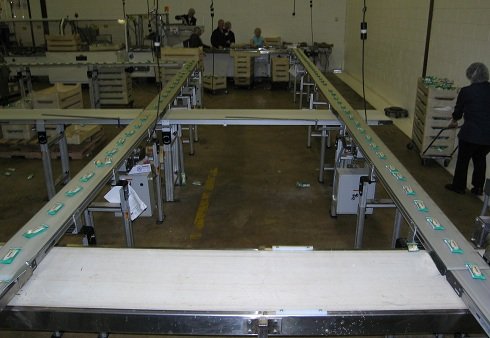
Equipment and operating figures
Figures describe the configuration and operating conditions in this case.
- Conveyors supplied
- 18, using 2200 and 6200 Series platforms
- Example lengths
- 5 feet 3.96 inches; 14 feet 9 inches; 16 feet 2.76 inches
- Belt widths
- 8–18 inches
- Operating pattern
- About 14 hours daily, 6 days weekly
- Historical budget comparison
- Around US$5,000 per conveyor at the time of the case
- Reported service period
- 2 years before the operating review
The process sequence
- Reconfigure the packaging area
- Feed three wrapping machines
- Transfer wrapped bars
- Connect downstream packaging
A line expansion that changed every transfer
The confectionery business normally fabricated conveyors with its own maintenance team. Its expansion added another wrapping machine to a line producing candy and functional health bars, bringing the total to three wrappers.
The existing floor arrangement could not accommodate the new machine without moving the other packaging equipment. As the machines changed position, the old conveyors no longer matched either the infeed routes to the wrappers or the transfers from the wrappers to the packing equipment.
This was therefore a coordinated layout problem rather than a single missing conveyor. Eighteen replacement conveyors had to connect the relocated machinery and fit the available spaces.
Comparing in-house fabrication with specified equipment
The engineer had intended to build the conveyors internally and typically allowed about US$5,000 per unit for motors, gearboxes and other components. As the project progressed, the remaining time was no longer sufficient for that fabrication work.
The purchased conveyors were reported to be close to that historical internal budget, while their delivery suited the installation schedule. This figure records the decision made at the time; it is not a present quotation, an allowance for shipping or a promise that current configurations cost the same.
Dimensions matched to the revised machinery
The installation used a mixture of 2200 and 6200 Series conveyors. Belt widths ranged from eight to eighteen inches, and the lengths were made to the routes rather than rounded to convenient stock sizes. Published examples include 5 feet 3.96 inches, 14 feet 9 inches and 16 feet 2.76 inches.
The original production account attributes the rapid fulfilment to made-to-order cellular manufacturing and records a four-day turnaround for these platforms. That is a historical supply example, not a current Roarer delivery commitment. Its engineering relevance is that precise dimensions could be ordered without redesigning the packing layout around a standard conveyor length.
Operating experience and later improvements
The eighteen conveyors ran for around fourteen hours a day, six days a week. At the two-year operating review, the customer reported that they were working well.
Tail-end design improvements developed after the original installation were applied to the conveyors to strengthen that part of the assembly. The operator also valued the modular construction because alterations could be made without extensive difficulty. The documented result covers both successful integration into the rearranged line and continued service under its stated working pattern.